Market Engineering
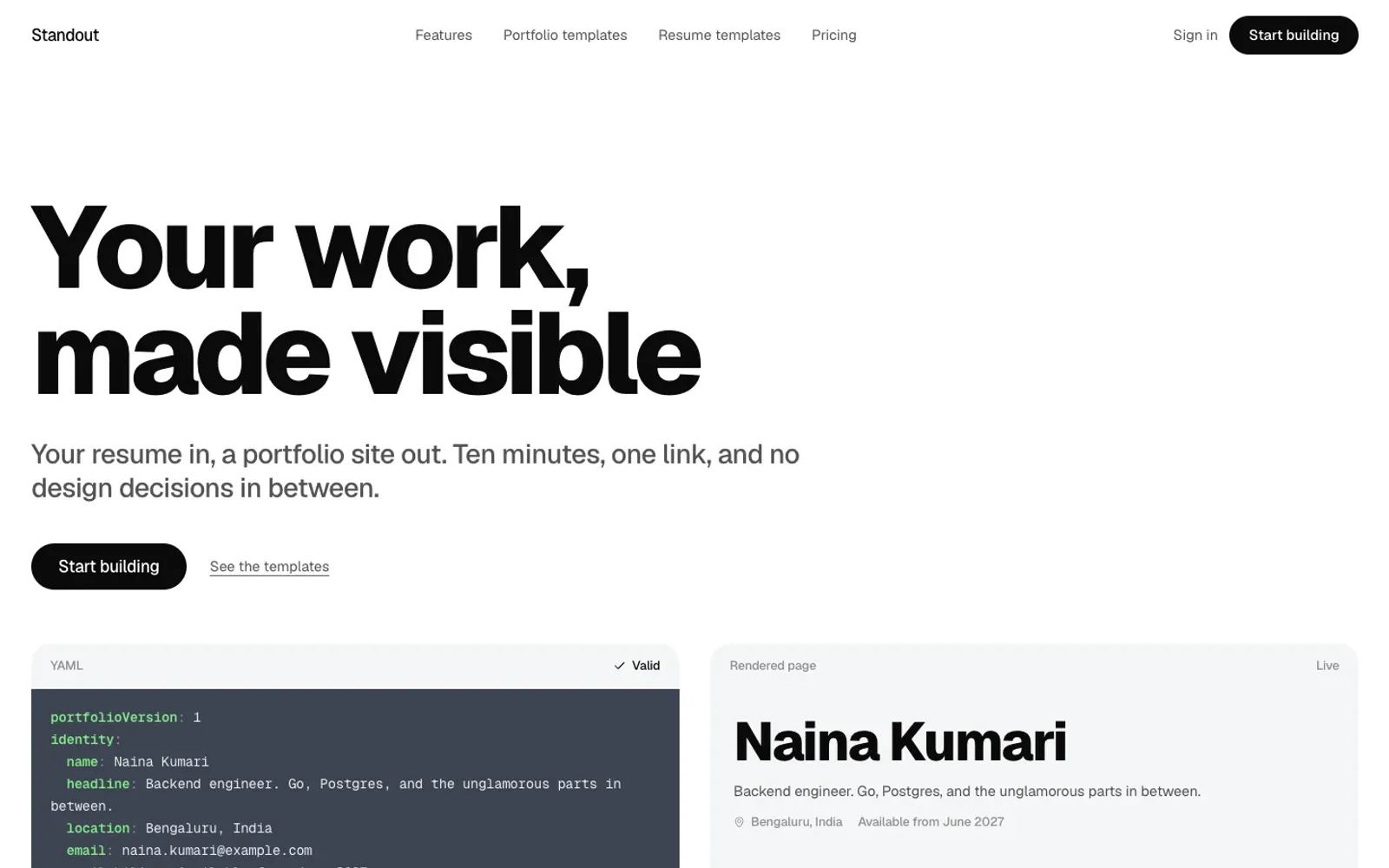
A portfolio and resume surface for engineers. One link, a few templates, and a layout that makes the work the argument instead of the decoration.
Stack Next.js · TypeScript · Tailwind CSS · PostgreSQL
Most engineering portfolios are résumés with a hero image. They list technologies, stack a few cards, and leave the reader to guess what the person actually did. Market Engineering is an attempt at the opposite: a small, opinionated surface where the work is the argument and the interface does not compete with it.
The product gives an engineer one link, a set of resume and portfolio templates, and a structure that makes the important parts hard to bury: what you built, what changed because of it, and what you would do differently.
The product question
If a recruiter gives a portfolio eleven seconds, what should they see? Not a skill cloud. Not a carousel. The strongest signal is usually a specific artifact with a short explanation: a system, a before-and-after, a decision that had a cost.
So the templates are built backwards from that artifact. Each one starts with a claim, then a piece of evidence, then the context that makes the evidence legible. The layout is quiet enough that the claim can be read at a glance. The typography does the hierarchy; there are no badges doing the work of a sentence.
The build
Next.js and TypeScript on the front, PostgreSQL for the profile records, and a component layer shared by the marketing site and the generated pages. The editor is a form, not a canvas. That was a deliberate trade: fewer degrees of freedom, but every exported page ships with a baseline of readable typography, sensible spacing, and a mobile layout that was actually designed.
The templates are the product. The rest of the app exists to get someone into one and out the other side with a link they are not embarrassed to send.
What I would keep
The empty state. A new profile starts with one prompt — What is the last thing you shipped that you would show a stranger? — and nothing else. It is the only question that reliably produces a real first paragraph.
The next iteration would add a proper import path for GitHub and a way to attach private work without exposing the repository. For now, the build is a clean proof: a portfolio can be a publication rather than a personal advertisement.
More from the build
Click any image. Arrow keys walk the set.